SpinShark Licence, Regulation and Trust for UK Players
 Available in GB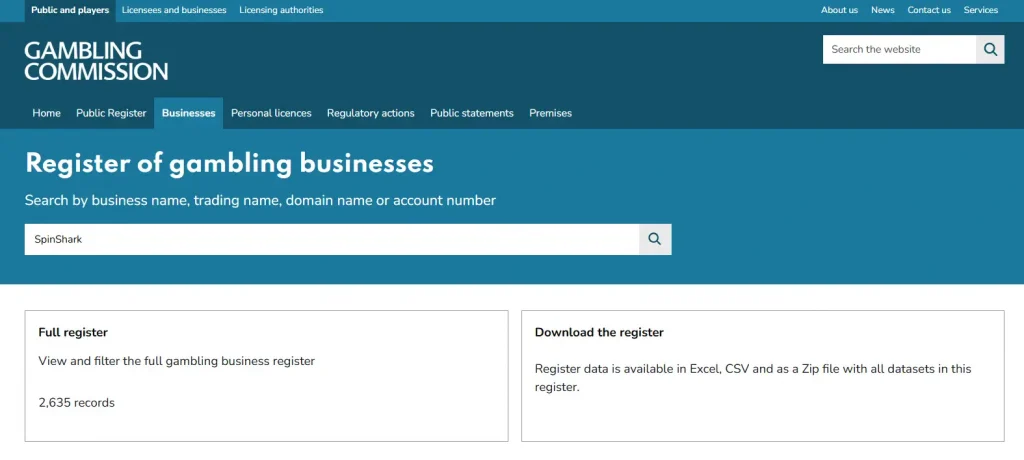
Table of Contents
- SpinShark is not listed as a UKGC-licensed operator
- Great Britain and Northern Ireland should not be collapsed into one licensing statement
- Protections verified for the licensed Great Britain market
- A licence claim needs a primary source, not repetition
- Curaçao licensing claims remain inconsistent
- Regulatory rules, operator policies and marketing claims are different things
- Trust is broader than licensing but licensing remains a concrete checkpoint
- A practical regulator-first check for Great Britain players
- Reviews can identify friction but cannot create regulatory status
- SpinShark licence questions for UK players
- What SpinShark's licence status means for UK players
Section element
Licence and regulation
SpinShark is not listed as a UK Gambling Commission licensee in the public register as of 28 September 2026. UKGC-specific protections such as GAMSTOP participation and UK ADR coverage therefore should not be attributed to the brand.
For consumers in Great Britain, remote operators generally need a UK Gambling Commission operating licence to provide gambling services. Northern Ireland has a separate gambling-law framework, so UK-wide wording can be misleading unless that distinction is made. That licensing position is relevant to players in Great Britain, while it does not by itself determine every legal question across the whole UK.
Section element
UKGC status
SpinShark is not listed as a UKGC-licensed operator
As of 28 September 2026, the UK Gambling Commission public register contains no matching operating-licence entry for SpinShark, its known brand variants or associated domains. Third-party descriptions do not change that register status.
This matters because a UKGC licence is not just a label. It is the gateway to a particular Great Britain regulatory framework, including mandatory safer-gambling requirements, rules on age verification, payment restrictions and technical standards. Those protections apply to the licensed Great Britain market and should not be assumed for a SpinShark account.
The licensing point is narrower than a general legal verdict. SpinShark is not listed as a UKGC licensee, so Great Britain regulatory coverage should not be assumed; that fact alone does not settle every wider legal question.
Regulatory scope
Great Britain and Northern Ireland should not be collapsed into one licensing statement
The UK Gambling Commission regulates commercial gambling in Great Britain, meaning England, Scotland and Wales. Operators providing remote gambling to consumers in Great Britain generally require a Gambling Commission operating licence. That is the relevant framework for most UK-facing online-casino comparisons.
Northern Ireland has a separate gambling-law framework. That does not make the Great Britain rules irrelevant to the rest of this page; it means a phrase such as “UK licensed” can hide an important jurisdictional distinction. A player in Belfast should not assume that every Great Britain licensing rule maps directly onto Northern Ireland simply because both are within the United Kingdom.
This page therefore uses “Great Britain” when discussing UKGC licensing requirements and licensed-market protections, and “UK” only when speaking more broadly about the audience or the site itself.
What a GB licence changes
Protections verified for the licensed Great Britain market
The following protections are useful comparison points because they are part of the regulated Great Britain market. They are not presented as verified SpinShark features.
| GB licensed-market protection | Current rule or benchmark | What this page says about SpinShark |
|---|---|---|
| Age verification | Licensed remote operators must verify age before deposit, free-to-play access or gambling. | Not used as proof of SpinShark practice. |
| GAMSTOP | Relevant Great Britain remote licensees must participate in the national online multi-operator self-exclusion scheme. | Participation is not claimed without a verified UKGC licence. |
| Online slots stake caps | £2 per game cycle for ages 18-24 and £5 for ages 25+ on licensed online slots. | Not claimed as a SpinShark product rule. |
| Credit-card gambling | Licensed businesses must not accept credit cards for online casino, betting or bingo. | Not used to infer SpinShark payment compliance. |
| Financial vulnerability checks | Light-touch checks are required across the licensed remote sector. | No SpinShark compliance claim is made. |
| Deposit limits | New RTS requirements from 30 September 2026 require gross deposit limits to be offered and described as deposit limits. | Used only as a market benchmark. |
Why register evidence outranks review badges
A licence claim needs a primary source, not repetition
Casino comparison sites often repeat licence jurisdictions, licence numbers or regulatory badges from one another. That can create the appearance of certainty even when the original source is unclear. For Great Britain licensing, the regulator register is the deciding primary source.
That approach protects players from two common errors. The first is assuming that a logo, footer badge or third-party review proves a current licence. The second is treating the absence of a badge as proof that no other legal or regulatory relationship exists anywhere. The public register gives the clearest answer to the specific Great Britain licensing question.
A future UKGC entry for the brand, a parent company or a recognised trading name would materially change this position. As of 28 September 2026, SpinShark remains absent from the UKGC public register.
Offshore licensing
Curaçao licensing claims remain inconsistent
Third-party descriptions of SpinShark’s offshore licensing are inconsistent. Some refer to Curaçao, but the available material does not establish one consistent current licence number. For that reason, no specific Curaçao licence number is stated here as settled fact.
Those claims can still be noted as third-party descriptions, but they should be kept separate from an established licensing record. A clearly identifiable current regulator entry or official operator licence record would provide a firmer basis for a specific offshore-licence statement.
Players should be especially cautious when a review site states a licence number without linking to an official register entry. A number can look precise while still being stale, mistyped or attached to a different company.
Reading licence claims
Regulatory rules, operator policies and marketing claims are different things
Three kinds of statement are easy to confuse. A regulator rule describes what licensed operators in a jurisdiction must do. An operator policy describes that business’s own terms or procedures. A marketing claim describes how the service is presented. They can overlap, but one does not automatically prove another.
For example, the UKGC rule on slot stake caps applies to licensed remote casino operators in Great Britain. It should not automatically be extended to a brand outside that licensed status. Likewise, a responsible-gambling page alone does not establish GAMSTOP participation.
The same distinction applies to dispute handling. Great Britain licensees operate within specific regulatory and alternative-dispute-resolution structures, but a customer-support email or complaint form is not evidence that those structures apply. UK ADR coverage, local consumer-protection membership and UKGC supervision therefore should not be attributed to SpinShark on the current licensing status.
Payments, KYC, bonuses and licensing also need to be considered separately. A bonus term can be current even when local licensing is absent, and a payment method can be available without implying a particular regulatory protection. One product feature should not be treated as proof of the brand’s overall regulatory status.
Trust signals
Trust is broader than licensing but licensing remains a concrete checkpoint
Licensing is one part of a wider trust assessment. Payment experience, verification friction, account controls, support responsiveness and the handling of complaints can all affect a player’s practical experience. Those topics are separate because they describe different parts of the customer experience.
The SpinShark withdrawals page covers cashout conditions without turning variable limits or processing times into fixed promises. The SpinShark registration page covers account preparation, while the welcome bonus and promotions page keeps promotional rules separate from regulatory status.
Keeping those topics separate also prevents a common reasoning error: a smooth withdrawal does not prove a local licence, and a frustrating support experience does not by itself prove the absence of one. Licensing status and service quality should therefore be judged as separate questions.
How to verify independently
A practical regulator-first check for Great Britain players
- Search the UK Gambling Commission public register for the brand name, known trading names and any identified parent company.
- Check the domain field on any matching entry. A company name alone is not enough if the website being used is not an approved trading domain.
- Read the licence status and activities rather than relying on a search-engine snippet.
- If no relevant entry is found, do not treat third-party badges as a substitute for the register.
- For any offshore licence claim, follow the same principle: use the relevant regulator’s own register or an official licence page for the number and status.
This process is slower than copying a licence claim from a casino review, but it produces a much cleaner answer to the question that matters: which regulator has actually verified the operator or domain?
Player reports
Reviews can identify friction but cannot create regulatory status
Current player-review material contains recurring complaints around withdrawals, verification, account closure and support, alongside some positive reports of successful payouts. Those reports are relevant to service quality, but they do not prove or disprove a licence.
For that reason the detailed sentiment analysis sits on the SpinShark player reviews page. This licence page uses review material only to identify questions worth checking independently, not to substitute for regulator evidence.
If a reviewer says the casino is “licensed” or “unlicensed,” that statement remains the reviewer’s claim unless it is supported by a primary register. The same applies to broad labels such as “safe,” “unsafe,” “legal” or “illegal.” Concrete evidence is more useful than a label.
Quick answers
SpinShark licence questions for UK players
Is SpinShark licensed by the UK Gambling Commission?
SpinShark is not listed as a UKGC licensee in the public register as of 28 September 2026.
Does that prove SpinShark is illegal throughout the UK?
No. The UKGC framework discussed here applies to Great Britain, and SpinShark’s absence from the register does not by itself amount to a blanket legal verdict for every part of the UK.
Can I assume GAMSTOP applies to SpinShark?
GAMSTOP participation is required for relevant Great Britain remote licensees. SpinShark’s current UKGC status does not provide a basis for treating the brand as a confirmed participant.
Does SpinShark have a Curaçao licence?
Third-party sources conflict on the Curaçao licensing claim, so no specific offshore licence number is stated here as established fact.
Practical impact
What SpinShark’s licence status means for UK players
SpinShark is not listed as a UKGC licensee in the public register as of 28 September 2026. For players in Great Britain, UKGC-linked protections such as GAMSTOP participation, UK ADR coverage and other safeguards tied to licensed status therefore should not be assumed. They remain useful reference points for what a regulated Great Britain operator is required to provide.
Regulation and day-to-day service experience are separate questions. The reviews and complaints page covers current user-report themes, the cashout page covers withdrawals, and the full SpinShark review brings the wider UK-facing picture together. A licensing fact should not be stretched into a verdict about every other part of the product.